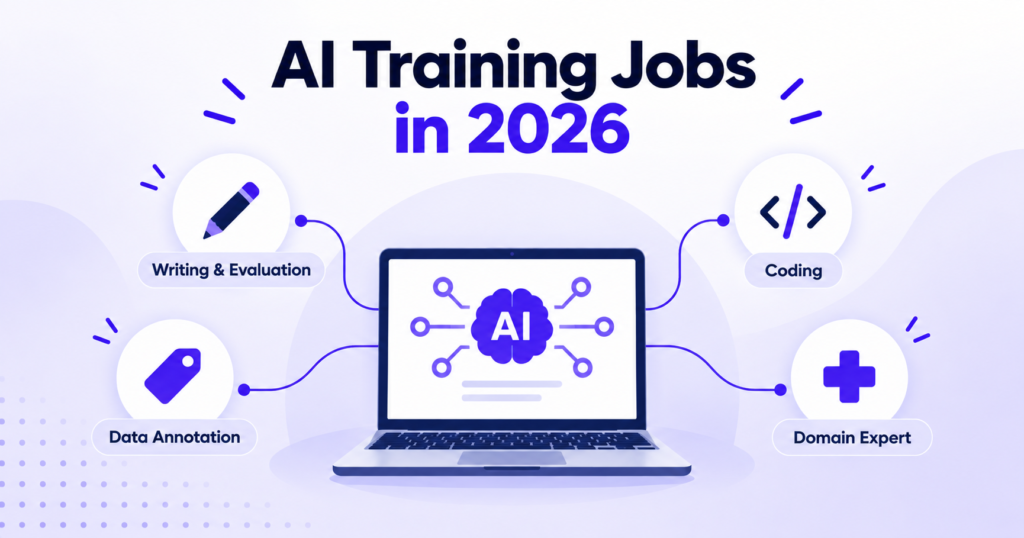
AI training jobs have become one of the fastest-growing categories of remote work, and for good reason. Every major AI company needs human contractors to evaluate, correct, and guide their models, and most of these roles require no coding background at all. If you are trying to understand the full landscape, from what the work actually involves to which platforms are hiring and what they pay, this guide covers it end to end.
Unlike a single-platform review, this is meant to be the starting point. From here, we link out to detailed breakdowns of specific roles, platforms, and pay rates so you can go deeper into whatever fits your background.
What Are AI Training Jobs?
AI training jobs involve helping improve artificial intelligence systems through human feedback and evaluation. Rather than building models, contractors in these roles review, correct, and guide a model’s outputs so it learns to perform better over time. This falls under a broader concept known as large language model development, where the quality of human-provided training data directly shapes how well the resulting system performs.
Most AI training jobs fall into a handful of categories:
- Response evaluation. Rating an AI’s answer to a prompt for accuracy, tone, and helpfulness.
- Data annotation and labeling. Tagging images, text, or audio so models can learn to recognize patterns.
- Prompt and response writing. Producing sample prompts and ideal answers that models learn from directly.
- Coding evaluation. Reviewing and rating AI-generated code across programming languages.
- Domain expert review. Evaluating AI outputs in specialized fields like medicine, law, and finance.
Furthermore, some contractors specialize in one category, while others rotate across several depending on task availability. For a closer look at the evaluation-focused side of this work specifically, see our guide on what an AI trainer actually does.
Who Hires for AI Training Jobs
A handful of platforms account for the large majority of AI training jobs currently available. Each has a different focus, application bar, and pay structure:
- DataAnnotation.tech. One of the most established platforms, with general, coding, and domain expert tracks. See our full DataAnnotation.tech review.
- Outlier AI. Scale AI-owned, with dedicated writing, coding, math, and domain expert tracks. See our Outlier AI review or the full breakdown of open roles.
- Mercor. Skews toward higher-paying, credentialed roles for domain experts. See our Mercor review.
- Remotasks. Also Scale AI-owned, focused on higher-volume annotation tasks. See our Remotasks review.
- Appen. One of the older players, with structured, project-based work. See our Appen review.
Instead of monitoring each platform separately, you can browse current openings across the ecosystem in one place at Talents for AI.
AI Training Jobs: Pay Rates in 2026

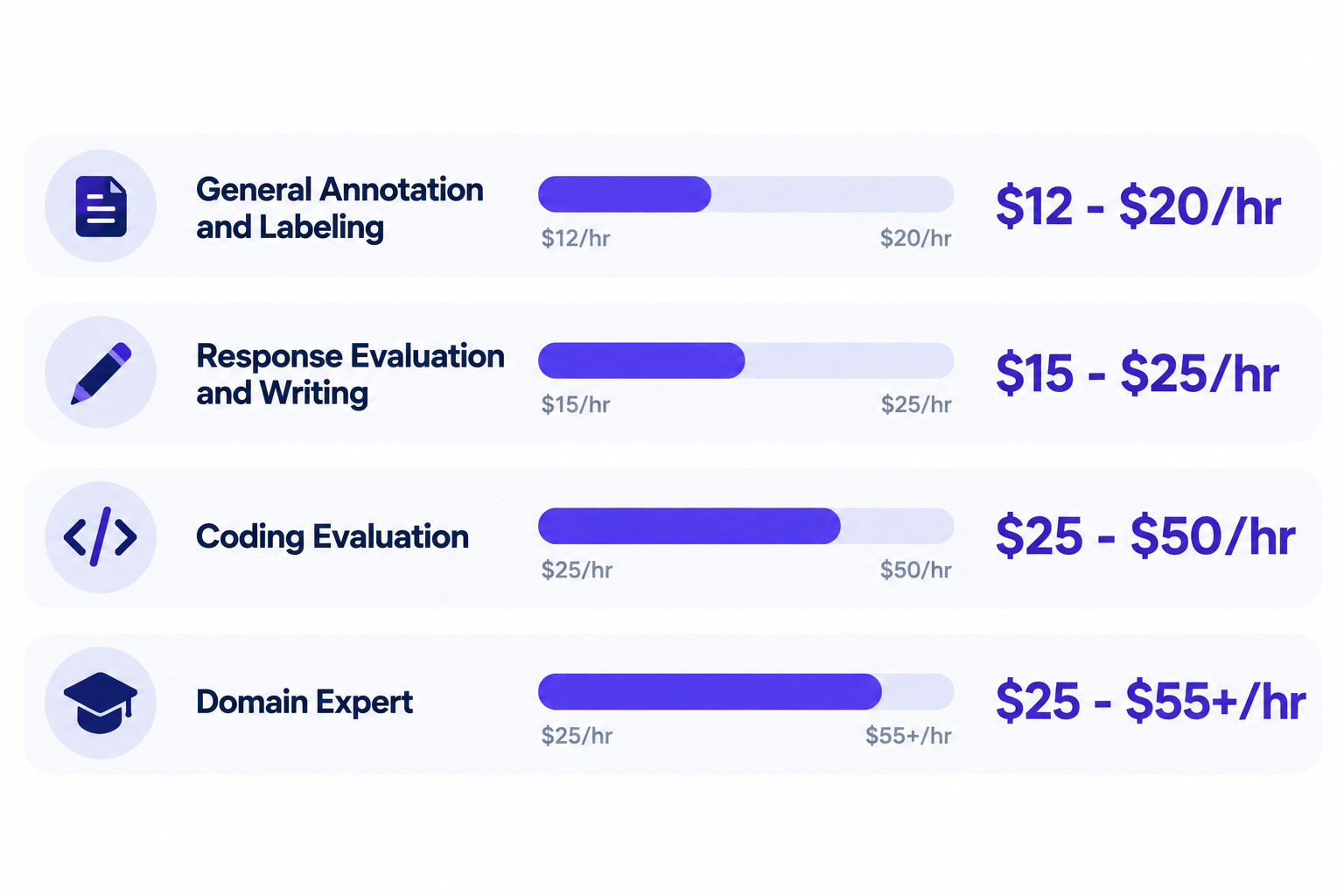
Pay depends heavily on task type and specialization. Across the major platforms, typical rates in 2026 look like this:
- General annotation and labeling tasks: $12 to $20 per hour.
- Response evaluation and writing tasks: $15 to $25 per hour.
- Coding evaluation tasks: $25 to $50 per hour.
- Domain expert tasks (medicine, law, finance): $25 to $55+ per hour.
Most platforms pay weekly via Stripe, Deel, or a similar contractor payment processor. In fact, payment reliability is rarely the issue across established platforms. The bigger variable most contractors report is inconsistent task supply rather than delayed or missing pay.
How to Apply for AI Training Jobs
The application process is broadly similar across platforms, with small variations:
- Create a profile. Basic sign-up covering your background, language skills, and areas of expertise.
- Complete a skills assessment. A writing sample, coding test, or domain knowledge evaluation depending on the track. This is where a significant share of applicants do not pass, so treat it as a real test.
- Finish onboarding tasks. A small set of guided tasks used to calibrate quality expectations before the full task board unlocks.
- Start accepting tasks. Once approved, you access available work on your own schedule.
Additionally, most platforms do not send a formal rejection notice. If you have not received task access within one to three weeks of finishing the assessment, you likely did not pass for that track, and applying to a different platform or specialty is generally fine.
AI Training Job Specializations
Once you have a general sense of the landscape, the fastest way to increase your pay ceiling is to move into a specialization that matches your background:
- Data annotation. A good entry point for beginners. See our guide to remote data annotation jobs and our data annotator jobs guide.
- Coding. Available on nearly every major platform, and consistently one of the highest-paying tracks.
- Healthcare and medical expertise. Nurses, doctors, and other medical professionals can move directly into domain expert review roles. See our guide to remote AI training jobs for nurses.
- Language and translation. Bilingual contractors are in steady demand for multilingual model training. See our guide to remote AI jobs for translators.
Moreover, if you are still deciding whether this type of work fits you at all, our beginner-focused walkthrough on how to get paid to train AI covers the basics without assuming any prior experience.
Skills You Need for AI Training Jobs
Most AI training jobs require no coding and no prior AI experience. What actually matters more is:
- Strong written English, since nearly every task involves reading detailed instructions and writing clear responses or feedback.
- Attention to detail, since task guidelines are often specific and consistency affects your quality score.
- Critical thinking, particularly for evaluation tasks where subtle errors need to be caught.
- Subject matter expertise, for anyone aiming at coding, math, medical, legal, or financial specializations.
Pros and Cons of AI Training Jobs
| Pros | Cons |
|---|---|
| No coding or degree required for most roles | Task availability fluctuates by platform and week |
| Fully remote, flexible schedule | General tasks pay less than specialized tracks |
| Multiple platforms to apply to simultaneously | Assessments are genuinely selective |
| Weekly pay on most platforms | Customer support varies by platform |
| Clear path to higher pay through specialization | No guaranteed hours or minimum income |
Final Verdict: Are AI Training Jobs Worth It in 2026?
AI training jobs remain one of the most accessible ways to earn AI-adjacent income, whether you have a technical background or not. The work is real, the platforms are established, and pay is transparent before you accept a task. That said, treating any single platform as a sole income source is risky given how task supply fluctuates.
The smartest approach is to apply to two or three platforms at once, choose a specialization that matches your background where possible, and build a quality track record early to unlock better-paying work over time. To see what is currently open across the major platforms in one place, browse current AI training jobs at Talents for AI.
Frequently Asked Questions
Do AI training jobs require coding skills?
No. Most AI training jobs involve writing, evaluation, or annotation tasks that require no coding at all. However, coding evaluation roles pay significantly more, typically $25 to $50 per hour, so programming skills expand your earning potential considerably.
Can you work AI training jobs part-time?
Yes. Nearly all AI training jobs have no minimum hour requirements. You accept tasks when they are available and when your schedule allows, which is why most contractors treat this work as supplemental income rather than a full-time replacement.
How long does the application process take?
Sign-up typically takes five to ten minutes. The skills assessment that follows can take anywhere from 30 minutes to a few hours depending on the platform and role. Access to paid tasks usually follows within one to three weeks of a successful assessment.
What countries are eligible for AI training jobs?
Most roles accept worldwide applicants. Payment is processed via Deel (160+ countries) or Stripe (46 countries). Sanctioned countries including Russia, Iran, North Korea, and Belarus are not eligible.
What equipment do you need for AI training jobs?
A laptop or desktop computer with a stable internet connection. Assessments and task work cannot be completed on mobile phones.