Data annotator jobs are one of the most accessible entry points into the AI industry in 2026. Companies building AI models need human annotators to label, tag, and review data – and they are hiring across dozens of languages and fields right now.
This guide explains exactly what data annotator jobs involve, how much they pay, and how to land your first position.
What Is a Data Annotator
A data annotator is someone who prepares raw data so that AI models can learn from it. In practice, this means reviewing content and adding labels, tags, or corrections that help the model understand patterns and improve its outputs.
Data annotation is a core part of how modern AI systems are trained. Without human annotators, AI models would have no reliable way to learn the difference between accurate and inaccurate responses. Learn more about data annotation on Wikipedia.
What Does a Data Annotator Actually Do

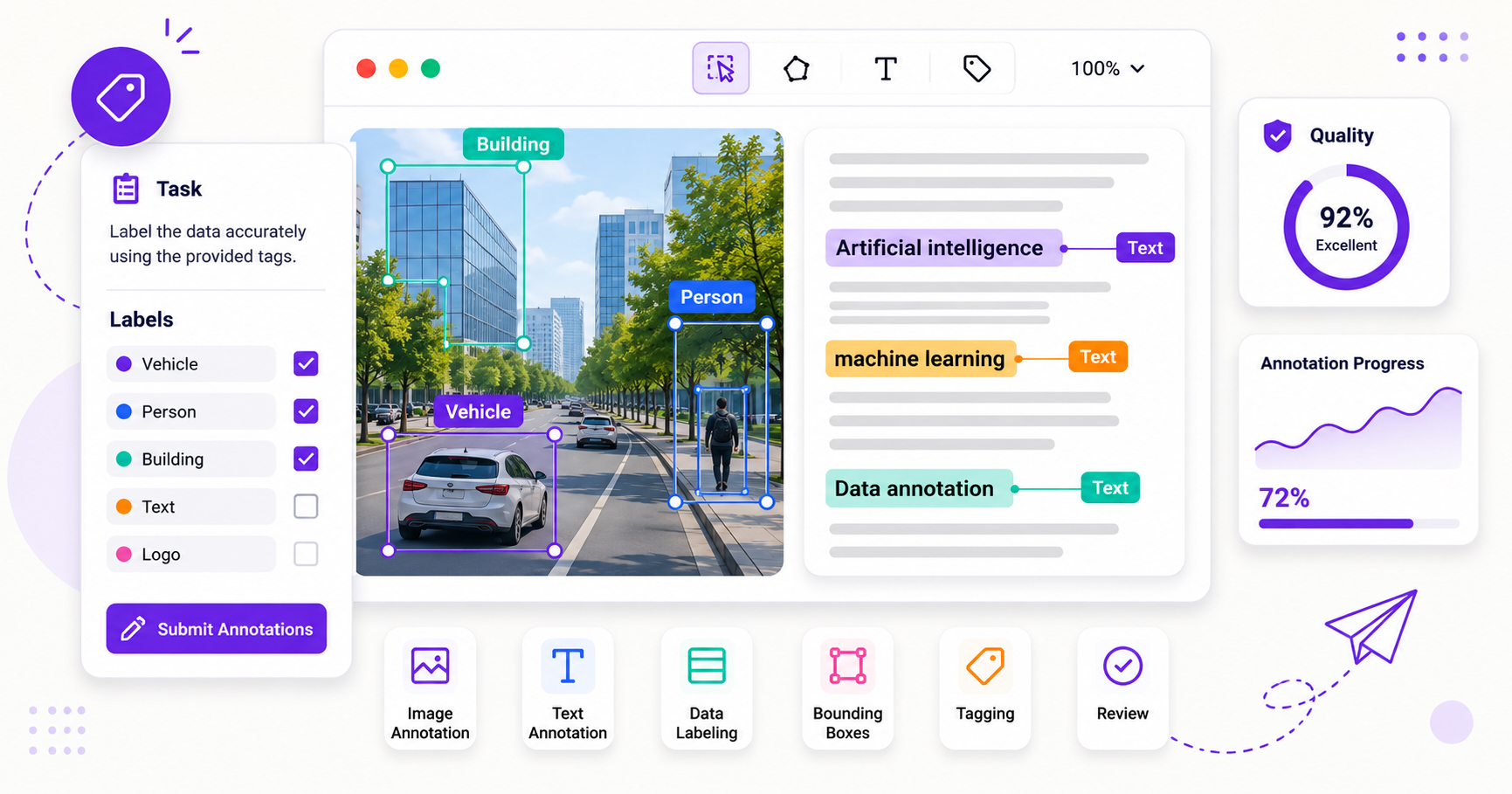
The specific tasks depend on the project and platform. However, most data annotator jobs involve some combination of the following:
- Labeling images, audio clips, or text with descriptive tags
- Rating AI-generated responses for accuracy, tone, and quality
- Comparing two AI outputs and selecting the better one
- Transcribing spoken audio into written text
- Identifying objects, entities, or sentiments within content
- Flagging harmful, incorrect, or unsafe AI outputs
- Writing improved responses for the model to learn from
Importantly, most of these tasks require no technical background. What matters is attention to detail, good judgment, and in many cases, fluency in a specific language.
Types of Data Annotator Jobs in 2026
Data annotation is not a single role. In fact, there are several distinct specializations depending on your background:
- Text annotation – labeling written content for sentiment, intent, or factual accuracy
- Image annotation – tagging objects, faces, or scenes in photos and video frames
- Audio annotation – transcribing and labeling spoken content for speech recognition models
- Language annotation – reviewing and improving AI outputs in a specific language
- Domain expert annotation – evaluating AI responses in specialized fields like law, medicine, or finance
Additionally, domain expert annotation tends to pay significantly more than general annotation tasks because fewer qualified people are available.
How Much Do Data Annotator Jobs Pay
Pay varies by task type, language, and expertise level. Here is a realistic breakdown based on current market rates in 2026:
- General image and text annotation: $10-$18/hour
- Language and translation annotation: $20-$40/hour
- Domain expert annotation (legal, medical, finance): $40-$100/hour
- Senior software engineering annotation: up to $175/hour
Furthermore, all roles on platforms like Talents for AI are paid weekly via Deel or Stripe with no minimum commitment. You work as many or as few hours as your schedule allows.
Who Can Apply for Data Annotator Jobs
The good news is that data annotator jobs are open to a wide range of professionals. The most in-demand profiles include:
- Translators and bilingual speakers – for language-specific annotation tasks
- Writers and editors – for text quality and tone evaluation
- Lawyers and legal professionals – for legal accuracy annotation
- Doctors and healthcare workers – for medical content review
- Software developers – for code annotation and review
- Scientists and engineers – for STEM subject matter evaluation
- Finance professionals – for financial reasoning tasks
Even without specialized expertise, entry-level annotation roles are available for anyone with strong attention to detail and good written communication skills.
Data Annotator Jobs vs AI Trainer Jobs
Many people use these terms interchangeably, but there is a distinction worth knowing:
- Data annotators primarily label and tag raw data to prepare it for training
- AI trainers evaluate and improve model outputs after the initial training phase
In practice, most platforms combine both types of work into the same role. However, understanding the difference helps you target the right job listings and set accurate expectations for the work involved.
Where to Find Data Annotator Jobs in 2026
Several platforms are actively hiring data annotators right now. The most reliable options include:
- Talents for AI – specialist platform connecting domain experts with vetted annotation contracts, weekly payments via Deel or Stripe
- SME Careers (SuperAnnotate) – enterprise annotation platform with roles across 50+ languages and domains, paying weekly via Deel
- Mercor – AI-powered hiring platform matching professionals with high-paying annotation projects, paying via Stripe
- Remotasks – entry-level annotation tasks, good for beginners with no prior experience
- Appen – long-running data collection and annotation platform with global reach
- Scale AI – higher-paying annotation tasks for experienced professionals
Browse open data annotator jobs on Talents for AI →
How to Get Hired as a Data Annotator
The application process is straightforward. Here is what to expect step by step:
- Browse open roles that match your language, field, or expertise level
- Submit a short application – typically takes about 5 minutes
- Complete an async interview on your laptop – 30 to 45 minutes at your own pace
- Pass a skills assessment specific to your role and field
- Start receiving paid annotation tasks once approved
The full vetting process takes up to 2 months depending on current demand. Moreover, applying to multiple roles at once increases your chances of getting matched to an active project faster.
Tips to Stand Out in Your Application
Competition for data annotator jobs is growing in 2026. Here are a few practical ways to improve your chances:
- Be specific about your expertise – mention your degree, certifications, or years of professional experience clearly
- List every language you speak fluently – including regional dialects, which can qualify you for higher-paying roles
- Take the skills assessment seriously – many applicants fail at this stage by rushing
- Apply early – project slots fill on a rolling basis and earlier applicants get priority access
Frequently Asked Questions
Do data annotator jobs require coding skills?
No. The majority of data annotation roles require no programming knowledge. Coding skills are only needed for software engineering-specific annotation tasks.
Can I do data annotation part-time?
Yes. All roles are hourly contractor positions with no minimum commitment. Many annotators work part-time alongside existing jobs or freelance work.
How long does it take to get started?
The application takes about 5 minutes. The full vetting process including the interview and skills assessment takes up to 2 months depending on the role and current volume.
Which countries are eligible?
Most roles accept worldwide applicants. Payment is processed via Deel (160+ countries) or Stripe (46 countries). Sanctioned countries including Russia, Iran, North Korea, and Belarus are not eligible.
What equipment do I need?
A laptop or desktop computer with a stable internet connection. Assessments and interviews cannot be completed on mobile phones.