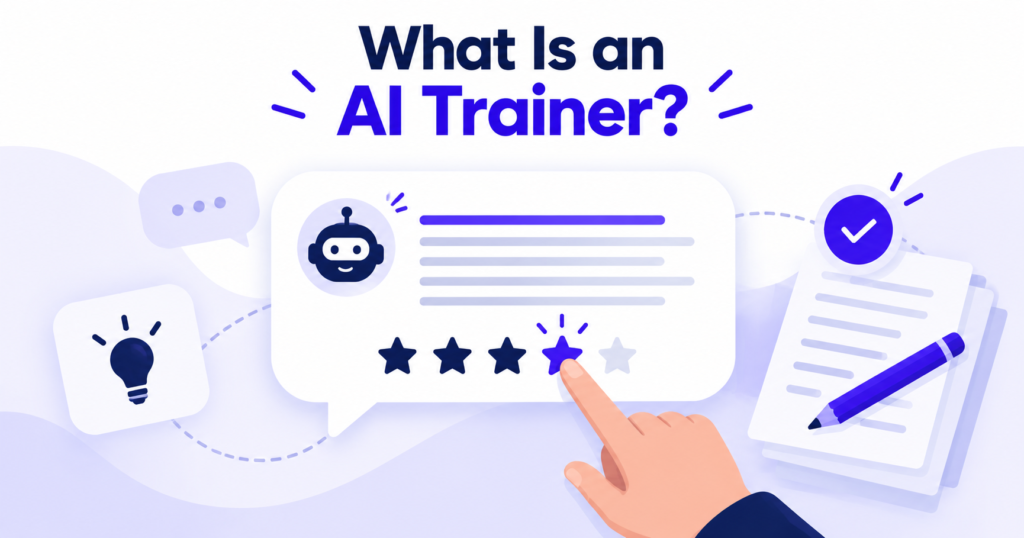
If you keep seeing the term but are not sure what it actually means, here is the short answer to what is an AI trainer: it is someone who helps improve artificial intelligence systems by evaluating, correcting, and guiding their outputs. AI trainers do not write code or build models. Instead, they teach AI systems through feedback, in much the same way a teacher corrects a student’s work.
The role has grown quickly alongside the rise of large language models like ChatGPT and other AI chatbots, and it is now one of the fastest-growing remote job categories that requires no technical background to get started.
What Is an AI Trainer, Exactly?
An AI trainer is a contractor who works on tasks that shape how an AI model responds, reasons, and behaves. This work is part of what is known as a human-in-the-loop process, where human judgment is used at key points to review, correct, and guide the system’s outputs. Over thousands of examples, this feedback shapes the model’s future behavior.
Importantly, an AI trainer is not the same as a machine learning engineer. Engineers build and tune the underlying model architecture. AI trainers work with the model’s outputs directly, evaluating quality, accuracy, tone, and helpfulness, and often writing sample responses that the model can learn from.
What Does an AI Trainer Actually Do Day to Day?
Daily tasks vary by platform and specialty, but most AI trainer work falls into a few core categories:
- Rating AI responses. Reading a chatbot’s answer to a prompt and scoring it for accuracy, clarity, tone, and helpfulness against a rubric.
- Writing sample responses. Producing an ideal answer to a given prompt, which the model uses as a reference point for what a good response looks like.
- Identifying errors. Flagging factual mistakes, unsafe content, bias, or reasoning errors in AI-generated text or code.
- Comparing outputs. Reviewing two or more AI responses to the same prompt and ranking them, which is one of the most common task formats across major platforms.
Furthermore, some AI trainer roles are specialized. Coders review AI-generated code. Domain experts in medicine, law, or finance evaluate AI responses within their field. Math and STEM specialists check quantitative reasoning. Each specialty tends to pay more than general writing and evaluation work.
What Skills Does an AI Trainer Need?
The good news is that most AI trainer roles require no coding and no prior AI experience. What actually matters is:
- Strong written English. Nearly all tasks involve reading detailed instructions and writing clear, well-structured responses or feedback.
- Attention to detail. Task guidelines are often specific and lengthy, and consistency in following them affects both your quality score and access to future work.
- Critical thinking. Spotting subtle factual errors or reasoning flaws in AI output requires more than surface-level reading.
- Subject matter expertise, for specialized roles. Coding, math, medicine, law, and finance backgrounds unlock higher-paying task tracks.
No degree is required for most general AI trainer roles. However, domain expert positions typically ask for verifiable credentials or professional experience in the relevant field.
What Does an AI Trainer Get Paid?

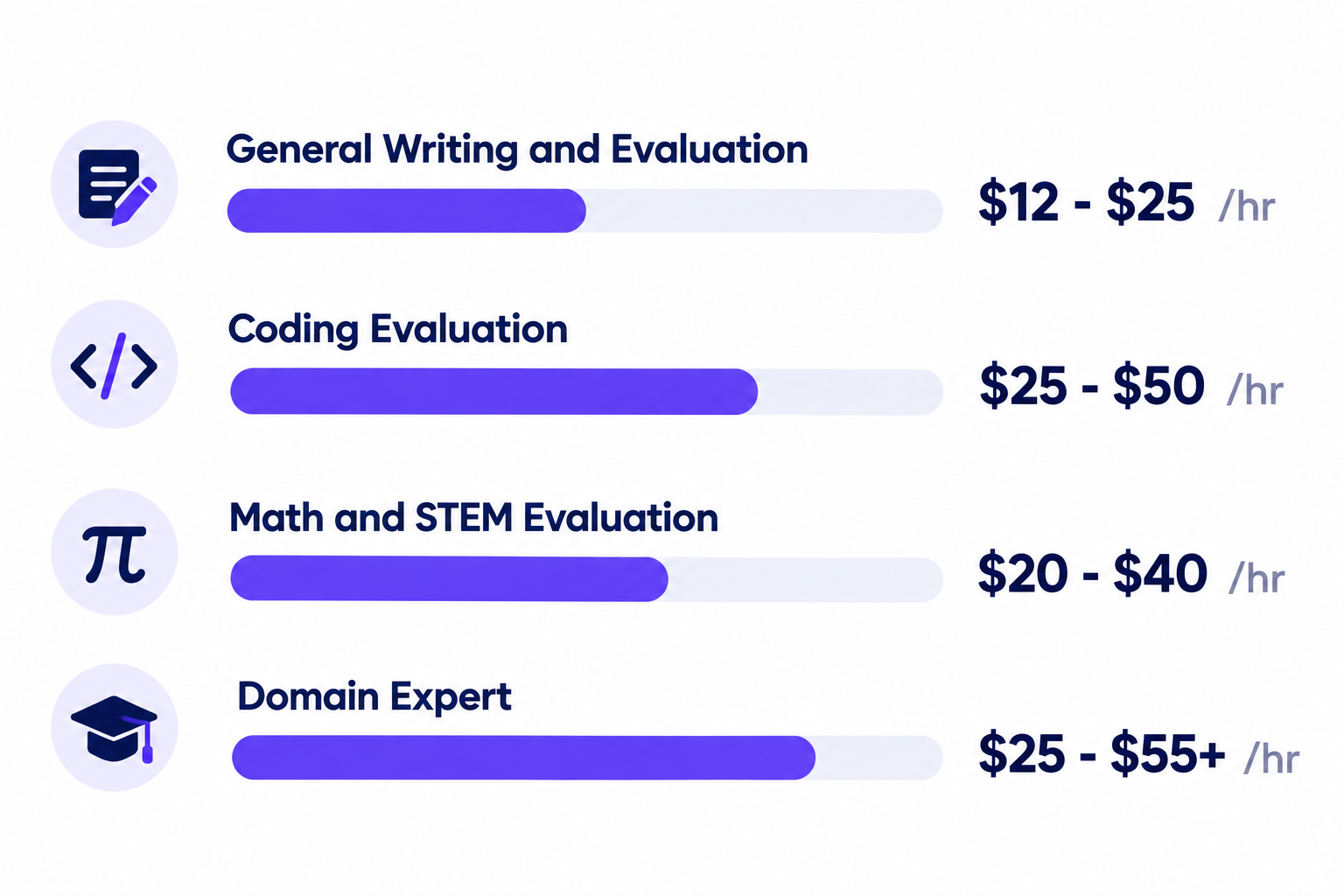
Pay depends heavily on task type and specialization. Across the major platforms, typical AI trainer rates in 2026 look like this:
- General writing and evaluation tasks: $12 to $25 per hour.
- Coding evaluation tasks: $25 to $50 per hour.
- Math and STEM evaluation tasks: $20 to $40 per hour.
- Domain expert tasks (medicine, law, finance): $25 to $55+ per hour.
Most platforms pay weekly. In fact, pay is usually the most transparent part of the job, since rates are typically shown before you accept a task. The bigger variable for most AI trainers is task availability, which can fluctuate significantly week to week.
AI Trainer vs Data Annotator: What Is the Difference?
These two terms get used almost interchangeably, but there is a meaningful distinction. A data annotator typically labels or tags raw data, such as marking objects in images or transcribing audio, work that is more repetitive and rule-based. An AI trainer more often evaluates and shapes model behavior directly through response rating, correction, and sample writing, work that leans more on judgment and reasoning.
In practice, many platforms use the two terms loosely, and a single contractor account can involve both types of tasks depending on what is available. If you want a broader look at annotation-specific roles, see our guide to remote data annotation jobs.
How to Become an AI Trainer
Getting started as an AI trainer usually follows the same basic pattern across platforms:
- Create a profile. Basic sign-up covering your background, language skills, and areas of expertise.
- Complete a skills assessment. A short writing sample, evaluation test, or domain knowledge check depending on the role.
- Finish onboarding tasks. A small set of guided tasks used to calibrate quality expectations.
- Start accepting tasks. Once approved, you access available work on your own schedule.
Moreover, applying to more than one platform is common practice, since task supply on any single site can vary from week to week. You can browse current openings across multiple platforms at once at Talents for AI.
Frequently Asked Questions
Does an AI trainer need coding skills?
No. Most AI trainer roles involve writing and evaluation tasks that require no coding at all. However, coding evaluation roles pay significantly more, typically $25 to $50 per hour, so programming skills expand your earning potential considerably.
Can you work as an AI trainer part-time?
Yes. Nearly all AI trainer roles have no minimum hour requirements. You accept tasks when they are available and when your schedule allows, which is why most contractors treat it as supplemental income rather than a full-time replacement.
How long does it take to become an AI trainer?
Sign-up typically takes five to ten minutes. The skills assessment that follows can take anywhere from 30 minutes to a few hours depending on the platform and role. Access to paid tasks usually follows within one to three weeks of a successful assessment.
What countries are eligible for AI trainer roles?
Most roles accept worldwide applicants. Payment is processed via Deel (160+ countries) or Stripe (46 countries). Sanctioned countries including Russia, Iran, North Korea, and Belarus are not eligible.
What equipment do you need to work as an AI trainer?
A laptop or desktop computer with a stable internet connection. Assessments and task work cannot be completed on mobile phones.