Remote data annotation jobs have become one of the most searched ways to earn money from home without a technical background. If you are looking for a role you can start from your laptop, with no office and no fixed schedule, this guide covers where the real openings are, what they pay, and how to actually get hired.
Data annotation work involves labeling, categorizing, or evaluating data so that AI systems can learn from it. This includes tagging images, transcribing audio, rating chatbot responses, and reviewing text for quality. Unlike many remote job categories that are oversaturated with applicants, remote data annotation jobs are still expanding as AI companies scale up their training pipelines.
What Remote Data Annotation Jobs Actually Involve
Not all annotation work looks the same. Depending on the platform and project, remote data annotation jobs can include:
- Text and image labeling. Tagging objects in photos, categorizing text by topic or sentiment, or drawing bounding boxes around items in images.
- AI response evaluation. Rating chatbot or AI model outputs for accuracy, tone, and helpfulness. This is one of the fastest-growing categories, and it forms the basis of reinforcement learning from human feedback, the training method behind most modern AI chatbots.
- Transcription and audio tagging. Converting speech to text and labeling audio for tone, language, or intent.
- Prompt writing. Writing sample prompts and ideal responses that models learn from directly.
Importantly, most remote data annotation jobs require no coding and no prior AI experience. What matters more is attention to detail, reading comprehension, and consistency in following task guidelines.
Where to Find Remote Data Annotation Jobs
Several platforms hire for annotation work on an ongoing basis. Instead of applying to each one separately, you can browse current openings across the ecosystem at Talents for AI, a free job board that aggregates listings from the platforms below in one feed.
- DataAnnotation.tech. One of the most established names in the category, with general, coding, and domain expert annotation tasks.
- Outlier AI. Scale AI-owned, with dedicated writing, evaluation, and math annotation tracks.
- Remotasks. Also Scale AI-owned, focused on higher-volume annotation tasks like image and video labeling.
- Mercor. Skews toward higher-paying, credentialed annotation and evaluation roles for domain experts.
- Appen. One of the older players in the space, with structured, project-based annotation work.
Furthermore, applying to more than one platform is common practice among experienced contractors, since task availability on any single platform can fluctuate week to week.
Remote Data Annotation Jobs: Pay Rates in 2026

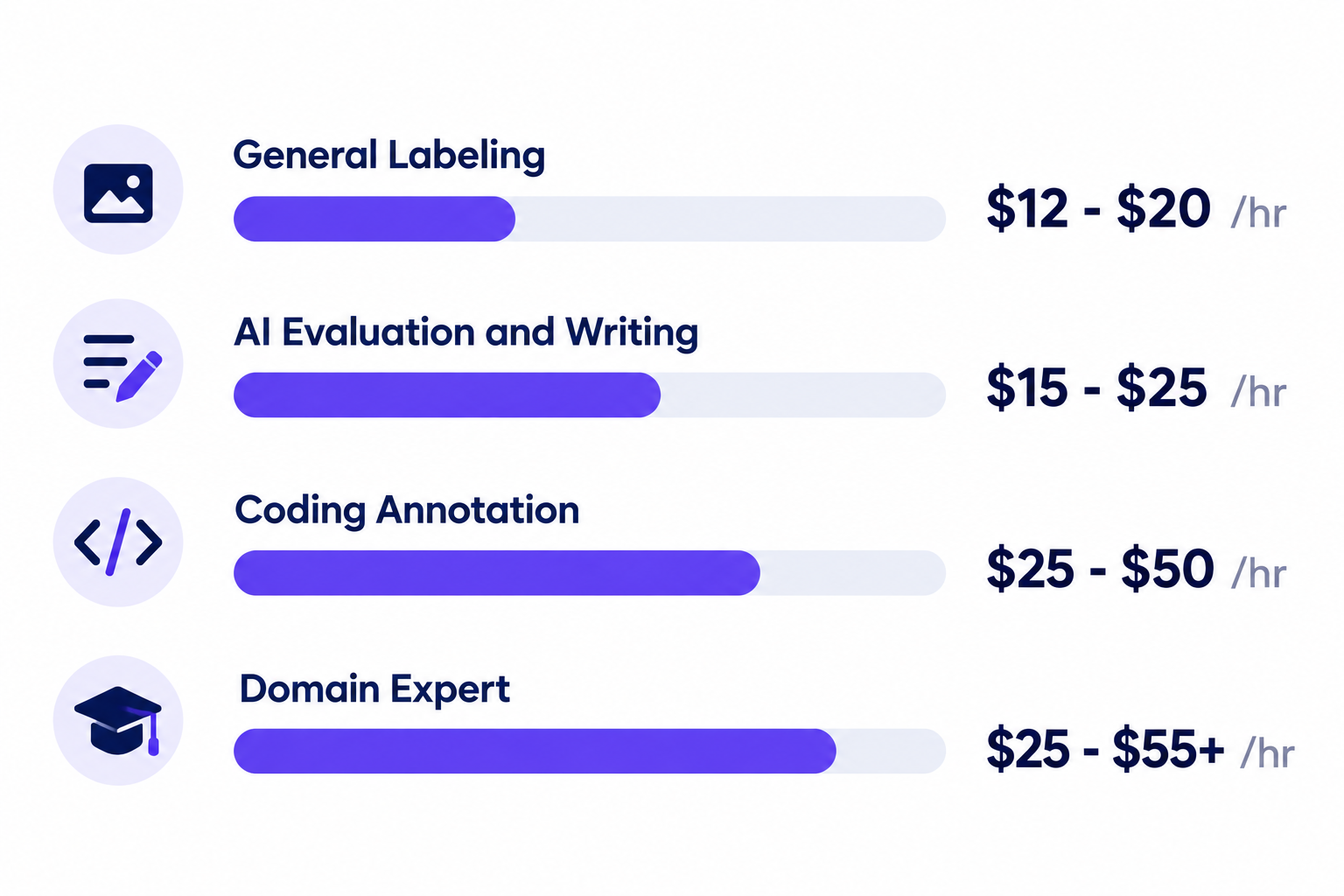
Pay varies by platform, task complexity, and whether the role is general or specialized. Here is a realistic range across the category:
- General annotation and labeling tasks: $12 to $20 per hour.
- AI response evaluation and writing tasks: $15 to $25 per hour.
- Coding-related annotation tasks: $25 to $50 per hour.
- Domain expert annotation tasks (medicine, law, finance): $25 to $55+ per hour.
Most platforms pay weekly via Stripe, Deel, or a similar contractor payment processor. In fact, payment reliability is rarely the issue with established platforms. The more common complaint among contractors is inconsistent task supply rather than delayed or missing pay.
How to Apply for Remote Data Annotation Jobs
The application process is broadly similar across platforms, though specific steps vary:
- Create a profile. Basic sign-up covering your background, language skills, and areas of expertise. Usually takes five to ten minutes.
- Complete a skills assessment. A short writing sample, labeling test, or domain knowledge evaluation. This step is where a meaningful share of applicants do not pass, so treat it seriously rather than rushing through it.
- Finish onboarding tasks. A small set of guided tasks to calibrate quality expectations before the full task board unlocks.
- Start accepting tasks. Once approved, you access available annotation work on demand.
Additionally, most platforms do not send a formal rejection notice. If you have not received task access within one to three weeks of finishing the assessment, you likely did not pass for that particular role, and it is generally fine to apply again for a different track or platform.
Skills That Help You Get Hired
You do not need a technical background for most remote data annotation jobs, but certain skills consistently improve your odds of passing assessments and staying active:
- Strong reading comprehension and attention to detail, since most tasks involve following specific, sometimes lengthy, guidelines.
- Clear written English, even for non-writing tasks, since instructions and feedback are almost always text-based.
- Consistency. Platforms track quality scores over time, and contractors who apply guidelines the same way every task tend to get access to more and better-paying work.
- For higher-paying tracks: demonstrated coding ability or verifiable professional credentials in fields like medicine, law, or finance.
Pros and Cons of Remote Data Annotation Jobs
| Pros | Cons |
|---|---|
| No coding or degree required for most roles | Task availability fluctuates by platform and week |
| Fully remote, flexible schedule | Lower-tier general tasks pay less than coding or domain expert work |
| Multiple platforms to apply to simultaneously | Assessments can be genuinely selective |
| Weekly pay on most platforms | Limited or slow customer support on some platforms |
| Entry point into the broader AI training job market | No guaranteed hours or minimum income |
Final Verdict: Are Remote Data Annotation Jobs Worth It in 2026?
Remote data annotation jobs remain one of the more accessible ways to earn AI-adjacent income without a technical background. The work is real, the platforms are established, and pay is transparent before you accept a task. However, treating annotation work as a sole income source is risky given how much task supply can vary.
Moreover, the smartest approach is to apply to two or three platforms at once, focus on building a strong quality track record early, and use a track record with clean history to unlock higher-paying specialized tasks over time. For a single place to see what is currently open across the major platforms, browse current AI training jobs at Talents for AI.
Frequently Asked Questions
Do remote data annotation jobs require coding skills?
No. Most annotation and labeling tasks require no coding at all. However, coding-related annotation tasks pay significantly more, typically $25 to $50 per hour, so programming skills expand your options considerably.
Can you work remote data annotation jobs part-time?
Yes. Nearly all platforms in this category have no minimum hour requirements. You accept tasks when they are available and when your schedule allows, which is why most contractors treat this as supplemental income rather than a full-time replacement.
How long does the application process take?
Sign-up typically takes five to ten minutes. The skills assessment that follows can take anywhere from 30 minutes to a few hours depending on the platform and task type. Access to paid tasks usually follows within one to three weeks of a successful assessment.
What countries are eligible for remote data annotation jobs?
Most roles accept worldwide applicants. Payment is processed via Deel (160+ countries) or Stripe (46 countries). Sanctioned countries including Russia, Iran, North Korea, and Belarus are not eligible.
What equipment do you need for remote data annotation jobs?
A laptop or desktop computer with a stable internet connection. Assessments and task work cannot be completed on mobile phones.