
In 2026, remote AI jobs for translators are among the fastest-growing opportunities in the language industry. AI companies need fluent speakers to help train their models, and they pay competitive hourly rates for fully flexible, remote work.
This guide covers which roles are available, which languages pay the most, and how to land your first position.
Why AI Companies Need Translators
AI language models learn from human feedback. To work accurately in languages beyond English, they need native or fluent speakers to review and improve their outputs. Specifically, companies hire translators to:
- Translate and localize AI-generated content
- Rate the quality of AI responses in their language
- Write natural-sounding example sentences for the model to learn from
- Identify cultural errors, unnatural phrasing, or mistranslations
- Evaluate whether AI outputs are accurate and appropriate for local audiences
Importantly, this work does not require a computer science background. Your language skills are what matter. Learn more about how AI language training works on Wikipedia.
Which Languages Are in Demand in 2026

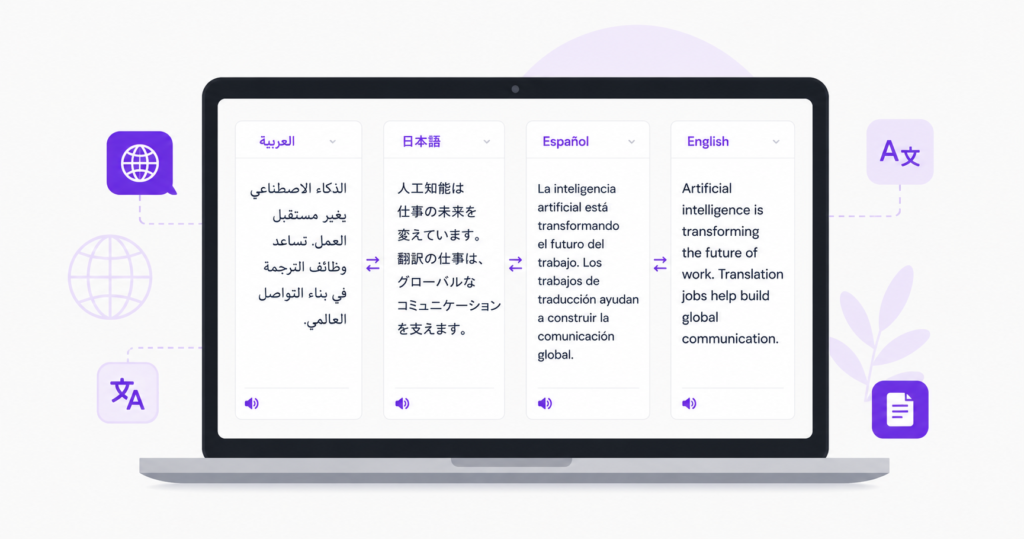
The most in-demand languages for AI training work right now include:
- Arabic – high demand across Egyptian, Gulf, and Levantine dialects
- Hindi and Indic languages – Bengali, Tamil, Telugu, Marathi, and others
- Japanese and Korean – especially for technical and conversational tasks
- Portuguese – both Brazilian and European variants
- German, French, Italian, Spanish – ongoing demand for European languages
- Vietnamese, Indonesian, Thai – growing demand across Southeast Asia
- Swahili, Yoruba, Hausa – moreover, African languages are increasingly prioritized
Additionally, less common languages often pay more because fewer qualified applicants are available. If you speak a regional or low-resource language, your earning potential is higher.
How Much Do AI Translation Jobs Pay
Pay depends on the language, task type, and platform. Here is a realistic breakdown based on current market rates:
- General translation and rating tasks: $15-$25/hour
- Localization and cultural review: $25-$40/hour
- Rare or low-resource languages: $30-$50/hour
- Senior linguistic review roles: up to $75/hour
All roles are paid weekly via Deel or Stripe. There is no minimum commitment, so you work as many or as few hours as you want.
What the Work Actually Looks Like
For example, a typical AI translation session involves these steps:
- You receive a prompt or AI-generated text in your target language
- You review it for accuracy, fluency, and cultural appropriateness
- You score it or rewrite it to a higher standard
- You submit your response and move to the next task
Sessions are fully async. There are no meetings, no deadlines, and no fixed schedule. You log in when it suits you and work from any laptop.
Requirements to Apply
To qualify for AI translation roles, you generally need:
- Native or near-native fluency in at least one language besides English
- Strong written communication skills in both languages
- A laptop or desktop computer (mobile phones are not supported for assessments)
- Availability in an eligible country for payment via Deel or Stripe
A formal translation qualification helps but is not always required. Furthermore, domain expertise in law, medicine, or technology can qualify you for higher-paying specialist roles.
How to Apply
The process is straightforward. Here are the steps:
- Browse open roles filtered by language or industry
- Submit your application – takes about 5 minutes
- Complete a short async interview on your laptop, 30 to 45 minutes
- Pass a language assessment specific to your role
- Start receiving paid tasks once approved
The vetting process can take up to 2 months depending on current volume. However, applying early gives you the best chance of getting into active projects.
Browse open AI translation jobs on Talents for AI →
Frequently Asked Questions
Do I need a translation certificate?
Not always. Many roles require fluency and writing quality rather than formal credentials. That said, having a certificate or degree in translation or linguistics strengthens your application.
Can I apply if English is not my first language?
Yes. Many roles involve bilingual tasks between two non-English languages. Others require English plus a second language. Check the specific role requirements before applying.
How many hours per week can I work?
There is no minimum or maximum. You work as much or as little as you want. Some contractors work a few hours a week alongside other jobs. Others work full-time hours during active project periods.
Which countries are eligible?
Most roles accept worldwide applicants. Payment is processed via Deel (160+ countries) or Stripe (46 countries). Sanctioned countries including Russia, Iran, North Korea, and Belarus are not eligible.
How long does the application take?
The application form takes about 5 minutes. The full vetting process including the interview and assessment takes up to 2 months depending on the role and demand.