If you are asking is Turing legit, you have probably come across it while searching for remote AI training or developer work. Turing has grown from a software engineer marketplace into what it now calls an AGI infrastructure company, and that shift changes who should actually consider applying. So, is Turing legit? Yes, it is a real, well-funded company that places contractors on paid work. But the experience varies more than most platforms in this space, and this review covers exactly why.
What Is Turing?
Turing started in 2018 as a marketplace connecting remote software engineers with US companies. In recent years, it has expanded significantly into artificial general intelligence infrastructure work, training and evaluating large language models for frontier AI labs. This means Turing now recruits well beyond software engineers, including healthcare professionals, lawyers, finance specialists, STEM graduates, and domain experts to write and grade AI training data.
The company is well capitalized. Turing raised a $111M Series E in March 2025 at a $2.2B valuation, bringing total funding to roughly $225M. That financial backing matters for a “is Turing legit” search specifically, since it rules out the platform being a fly-by-night operation.
Is Turing Legit? The Honest Verdict for 2026
Yes, Turing is legit. It is venture-backed, pays contractors in USD, and charges nothing to apply. However, several things are worth understanding before you commit time to the application:
- Reviews are unusually polarized. Trustpilot shows a TrustScore of roughly 2.5 out of 5 across 200+ reviews, with about two-thirds five-star and a quarter one-star. There is very little middle ground, contractors tend to either have a strong positive experience or a frustrating one.
- There is a real wait between passing assessments and getting paid work. Turing places approved contractors into a talent pool rather than guaranteeing immediate work. Some contractors report waiting three to four months for a project match.
- Most roles expect Pacific time overlap. Many contracts require several hours of daily availability during US Pacific business hours, which can be a genuine obstacle depending on your time zone.
- Contractor roles carry no benefits. No health insurance, no paid leave. This is standard for contractor-based platforms in this space, but worth confirming you understand before applying.
Turing Job Types in 2026
Turing job listings fall into a few distinct categories, and which one fits you depends heavily on your background:
- LLM Trainer roles. Reviewing, writing, and grading training data for large language models. No software engineering background required for most of these.
- Domain expert evaluation. Rating AI responses in a specialty field such as medicine, law, or finance. This is where Turing most directly overlaps with the domain expert roles covered elsewhere on this site.
- Code generation review. Evaluating AI-generated code for correctness and best practices, a strong fit for developers.
- Software engineer placement. Turing’s original product, full-time and contract engineering roles placed with client companies. This track involves a more intensive vetting process, including a live coding challenge.
Furthermore, the AI training and domain expert tracks are generally part-time friendly and do not require the same intensive technical vetting as the engineering placement track.
Turing Pay Rates in 2026

Turing does not publish a fixed public rate card for contractors, and pay varies by role type and experience:
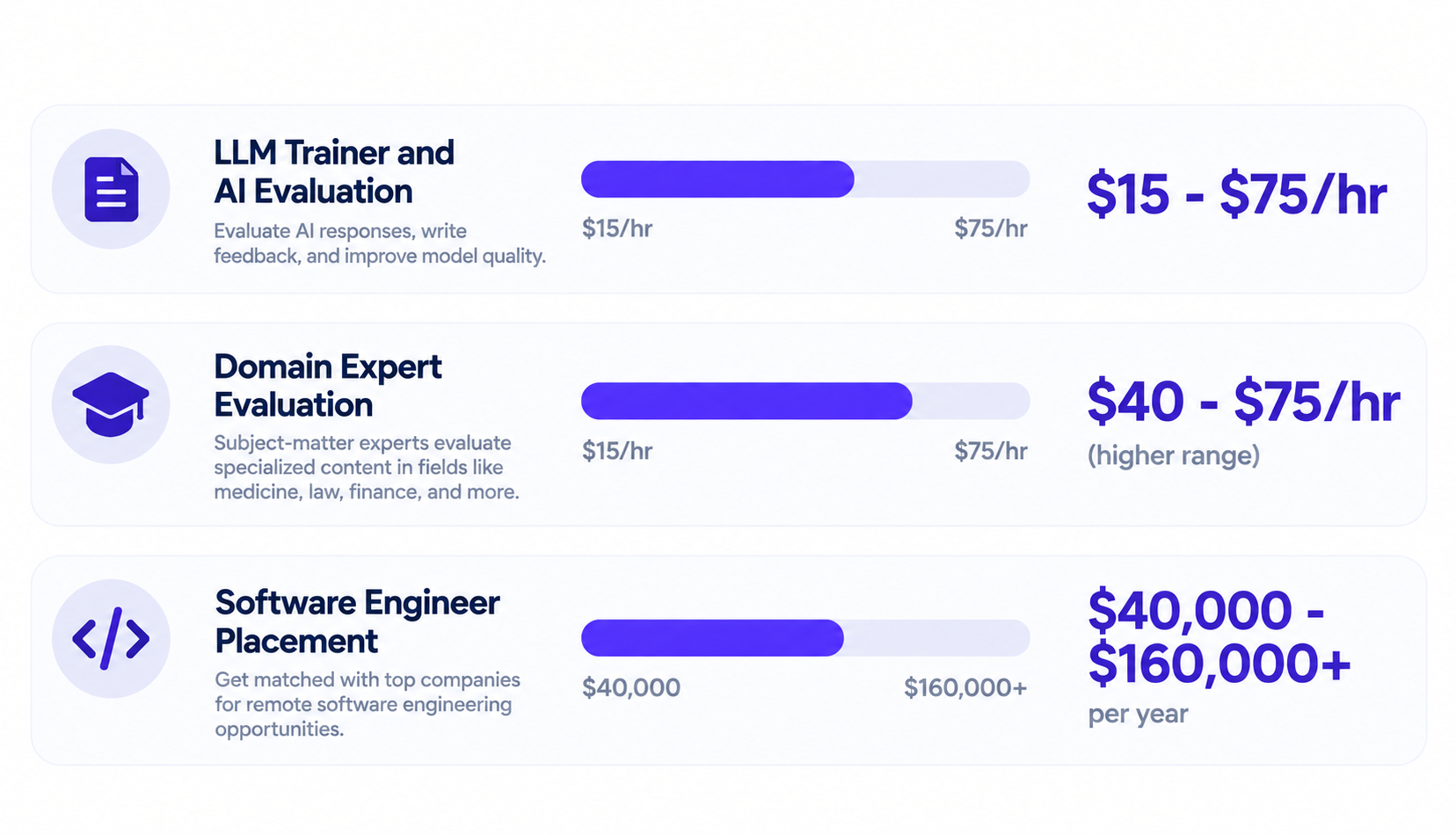
- LLM Trainer and general AI evaluation roles: Publicly reported salary data puts this around $30 per hour on average, with a broader reported range of roughly $15 to $75 per hour depending on task complexity and experience.
- Domain expert evaluation roles (medicine, law, finance): Typically toward the higher end of that range, though Turing generally discloses exact rates only after you apply to a specific listing.
- Software engineer placement roles: Paid as ongoing contract or salaried positions, with reported compensation ranging from roughly $40,000 to $160,000+ annually depending on seniority and client engagement.
Importantly, since Turing quotes many roles individually rather than publishing a flat rate, it is worth treating any figure you see, including the ranges above, as a planning estimate rather than a guarantee.
The Application and Onboarding Process
The application process differs slightly depending on which track you are aiming for, but generally follows this pattern:
- Create a profile. Upload your resume, which auto-populates most of your profile. Takes a few minutes.
- Apply to a specific role. A role-specific form appears based on your background and the listing you select.
- Complete an assessment. For AI training and domain expert roles, this is typically a written or subject-matter test. For the engineering track, this includes a seniority assessment, a tech stack test, and a live coding challenge.
- Interview, if applicable. Some roles include a call with Turing’s team before matching.
- Join the talent pool. Once approved, you are not always immediately matched to paid work. This is the step where wait times vary most.
Several contractor reviews describe the process itself, from application to test, as fast and well organized, often completed within three to four days. Additionally, some reviews note that onboarding communication after being matched to a project could be clearer.
Turing Reviews: What Real Contractors Say
Drawing from Trustpilot and Glassdoor, here is a fair summary of what contractors report in 2026:
Positive themes:
- The application and testing process is efficient, often completed in a few days.
- Payments arrive on time once a contractor is placed on a project.
- Exposure to real, cutting-edge LLM training work with frontier AI labs.
- Flexible working hours once matched to a project.
Negative themes:
- Long, sometimes multi-month waits in the talent pool after passing assessments.
- Limited ability to get reconnected to new contracts after a project ends.
- No benefits, paid leave, or job security, standard for contractor roles but worth planning around.
- Communication delays tied to Pacific time zone overlap requirements.
Moreover, the split between glowing and frustrated reviews tracks closely with whether a contractor actually got matched to steady work. Contractors who land a project tend to rate the experience highly. Those stuck in the talent pool for months are the source of most of the negative reviews.
Pros and Cons Summary
| Pros | Cons |
|---|---|
| Well funded, backed by major venture investors | Reviews are unusually polarized |
| Fast, efficient application and testing process | Talent pool wait can run three to four months |
| Roles open to non-engineers with domain expertise | Most roles require Pacific time overlap |
| Payments arrive reliably once placed | No benefits or paid leave for contractors |
| Real exposure to frontier LLM training work | Limited path to steady, ongoing contracts |
Is Turing Legit Compared to Alternatives?
Turing is legitimate, but whether it is the right platform depends on your background and how quickly you need paid work.
Talents for AI is a free job board that aggregates AI training roles from top platforms in one place, including Mercor and SME Careers. Rather than sitting in a single talent pool and waiting, you can browse current openings across several platforms at once and apply broadly while you wait to hear back from any one of them. Browse current AI training jobs at Talents for AI here.
Mercor also recruits domain experts for AI evaluation work and tends to match contractors to projects faster than Turing’s talent pool model, though its screening process is similarly selective.
SME Careers is purpose-built for subject matter experts in medicine, law, and finance, without the added layer of a general engineering marketplace attached to it.
DataAnnotation.tech and Outlier AI are better fits if you want on-demand task access without a placement-style waiting period, though their per-task pay ceiling for non-technical roles tends to run lower than Turing’s domain expert rates.
Final Verdict: Should You Apply to Turing in 2026?
Is Turing legit and worth applying to in 2026? Yes, with a clear-eyed view of the trade-off. Turing is a strong fit if you have engineering, STEM, healthcare, legal, or finance experience, can work several hours inside the Pacific business day, and have other income while you wait to be matched. Treat passing the assessments as joining a queue rather than starting a job immediately.
It is a weaker fit if you need paid work to start within days, or if a Pacific time overlap genuinely will not work with your schedule. In that case, applying to a platform with faster, on-demand task access alongside Turing is the more realistic approach.
Frequently Asked Questions
Does Turing require coding skills?
No. LLM Trainer and domain expert evaluation roles do not require coding. However, the software engineer placement track and the code generation review roles do require demonstrated programming ability, and these are typically the highest-paying roles on the platform.
Can you work part-time on Turing?
Yes, for AI training and domain expert roles. These tracks are generally part-time friendly. Software engineer placement roles are more often structured as full-time contracts once matched to a client.
How long does the Turing application take?
The application and assessment itself typically takes a few days. However, being matched to actual paid work after passing the assessment can take considerably longer, with some contractors reporting waits of three to four months in the talent pool.
What countries are eligible for Turing jobs?
Most roles accept worldwide applicants, though many require several hours of overlap with US Pacific time. Payment is processed via Deel (160+ countries) or Stripe (46 countries). Sanctioned countries including Russia, Iran, North Korea, and Belarus are not eligible.
What equipment do you need for Turing jobs?
A laptop or desktop computer with a stable internet connection. Assessments and interviews cannot be completed on mobile phones.